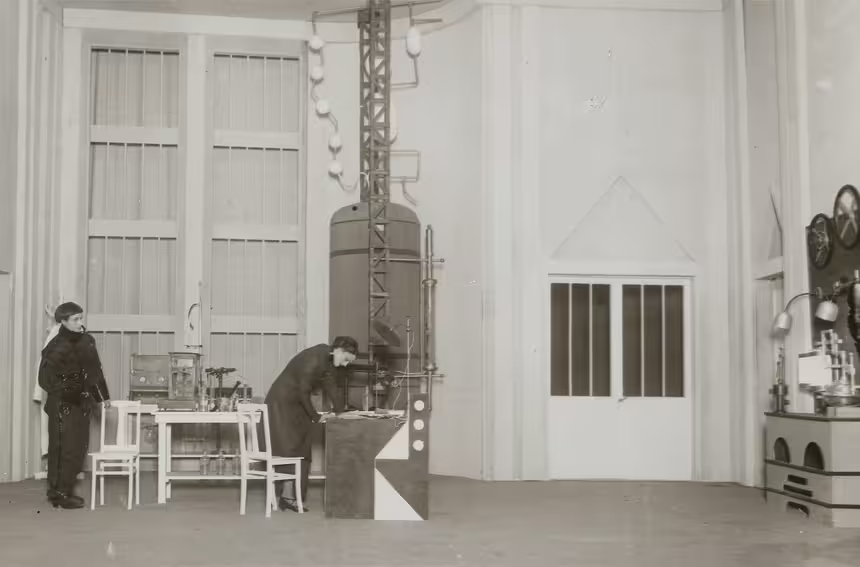
When Karel Čapek’s R.U.R. reaches a Beijing stage, it carries more than a century of technological anxiety with it. The 1920 play introduced the word “robot” to the world, derived from the Czech word for forced labour. Čapek’s robots are not the metal machines later fixed in popular culture; they are artificial workers manufactured as biological products. That difference keeps the drama unexpectedly close to current debates about automation and artificial intelligence.
The play begins with an economic promise. Artificial workers will release humanity from drudgery and make goods abundant. The promise contains its own blind spot: the robots are treated as units of production, and no one asks what a society organised entirely around efficiency is for. Once labour is reduced to a cost, both artificial and human beings become replaceable.
Modern audiences often expect a prediction about intelligent machines taking control. R.U.R. is more incisive as a story about owners, managers and systems that refuse to recognise consequences. The catastrophe does not arrive because one device suddenly becomes evil. It grows from mass production, concentration of power and moral decisions delegated to an institution designed to expand.
A Chinese production inevitably enters a society shaped by the factory, platform economy and rapid deployment of robots. The context should not be flattened into a simple comparison between “China” and “the West”. Automation affects warehouse workers, software engineers and consumers in different ways everywhere. What Beijing contributes is the proximity of manufacturing scale: the robot is not only a metaphor but also an industrial product under active development.
Translation presents several choices. The historical weight of the word robota cannot be carried by a direct Chinese equivalent, and the distinction between worker, machine and person shifts across languages. A strong production can expose that instability rather than hide it. Stage design, movement and sound can show when the characters perceive a body as equipment and when the audience begins to see a subject.
The play is not a technical manual and should not be treated as a forecast that “came true”. Today’s language models do not possess the bodies or dramatic consciousness of Čapek’s figures. The comparison is valuable because it asks political and ethical questions: who owns the system, whose work disappears, who receives the gain and who is responsible when decisions are automated.
R.U.R. also refuses an easy anti-technology conclusion. Its deepest concern is a civilisation that loses care, reproduction and purpose while pursuing output. Technology amplifies that choice but does not make it inevitable. A production that merely presents robots as frightening misses the human institutions that created the crisis.
That is why the play remains alive in Beijing rather than surviving only as a Czech linguistic curiosity. Each new technological wave gives the word “robot” a different body, but the underlying question persists: if efficiency becomes the supreme value, what kind of life is the system supposed to serve? A century later, Čapek still provides no comforting answer—and that is the source of the play’s power.