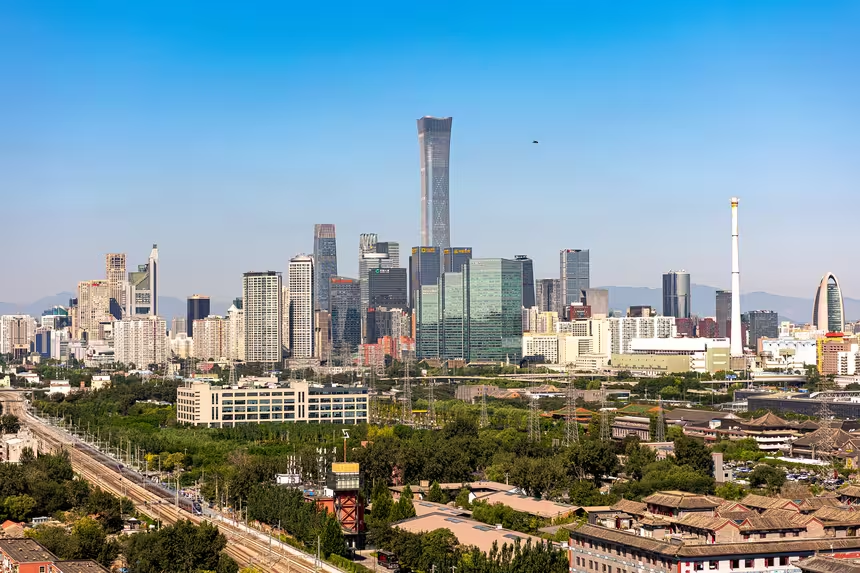
The image of Beijing hidden behind a grey curtain became a European shorthand for Chinese industrialisation. Today’s situation is more complicated. Over two decades the city sharply reduced fine particles and sulphur dioxide while continuing to grow. This was not the achievement of a single invention, but the combined effect of an energy transition, stricter emission rules, limits on coal, transport controls and cooperation with surrounding provinces.
The programme began intensifying in the late 1990s and acquired measurable targets and exceptional funding after 2013. A United Nations Environment Programme review found that Beijing’s PM2.5 pollution fell by 35 per cent between 2013 and 2017. Municipal figures for 2023 reported a reduction of more than 64 per cent in average PM2.5 concentration compared with 2013. Figures covering different periods should not be mixed without explanation, but they confirm the same sustained trend.
Heating and industry were transformed. Coal boilers gave way to gas and electricity, polluting plants were upgraded, closed or relocated, and construction dust came under tighter control. Moving a factory beyond an administrative boundary alone cannot solve the problem, because particles and ozone precursors travel across the region. Beijing therefore needed coordination with Tianjin and Hebei, not merely a cleaner city centre.
Transport is the second part of the story. Beijing restricted registrations of new combustion-engine cars, tightened emission standards, retired older vehicles and expanded both the metro and electric mobility. No measure has the same effect in isolation. A low-emission new car does not eliminate congestion, tyre particles or the use of public space; high-quality public transport changes the entire modal mix.
Success against PM2.5 does not mean that every day is healthy. Results fluctuate with weather, dust storms and regional transport. Ground-level ozone is becoming more important. It is created by chemical reactions between nitrogen oxides and volatile compounds in sunny, hot conditions. Ozone cannot be removed by a filter on one chimney, and reducing one pollutant does not automatically reduce all the others.
Communication also needs care. China’s national limit, European standards and World Health Organization recommendations are not identical. A day described as compliant in a local statistic may not meet the strictest health guideline. Visitors should follow measured concentrations and health warnings, especially if they have asthma or cardiovascular illness, or travel with small children.
Checking the air-quality forecast should be as routine as checking temperature. During a high-pollution episode, strenuous exercise and a long outdoor route can be moved to another day, while a museum becomes the better choice. A well-fitting particulate respirator can help against fine particles; an ordinary surgical mask does not provide equivalent protection. One bad day, however, is not evidence against the long-term improvement.
Beijing’s experience matters because of the scale of coordination it required. It demonstrates that visible progress can arrive within years when heat, industry, transport and regional pollution are tackled together. It also warns against triumphalism. Once the most obvious smog has been reduced, the remaining problems are more expensive and more dependent on atmospheric chemistry and climate.