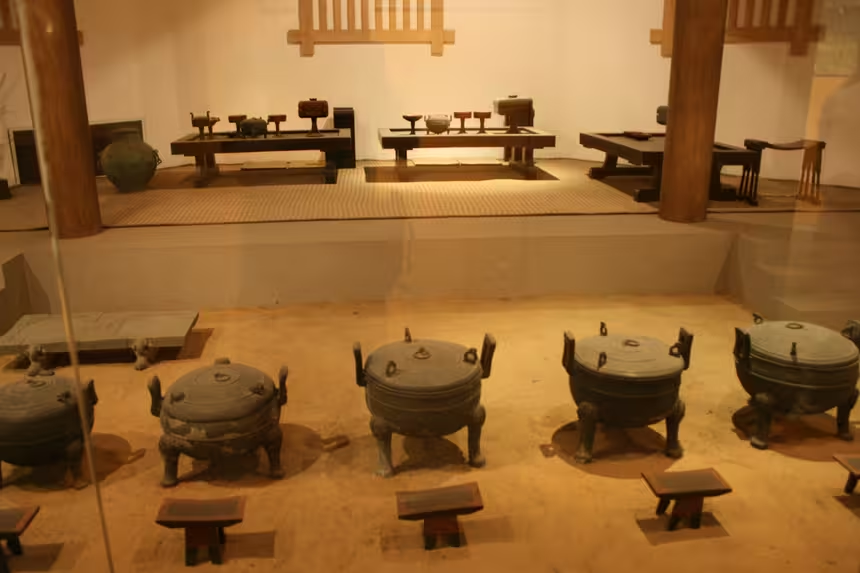
A Peking University team spent fourteen years mapping more than 23,000 ancient Chinese bronzes held in almost thirty countries. The resulting sixty volumes cover museum collections, private holdings and auction records. The scale is monumental, but the real achievement is less spectacular: objects whose histories were scattered among catalogues and archives now acquire a shared documentary trail.
Bronze vessels, weapons and ritual objects are not simply examples of craftsmanship. Inscriptions, casting methods and archaeological context reveal political ties, lineages and ceremonies in early China. When an object is removed from a site without documentation, part of that evidence disappears. Even a perfectly preserved vessel can lose research value when its place and circumstances of discovery are unknown.
Provenance means the documented chain of ownership and movement, not merely the name of the latest collector. Researchers look for inventories, export permits, dealers’ correspondence, exhibition photographs and excavation records. Gaps are common and do not prove theft on their own, but they cannot be ignored—especially when an object entered the market during war, colonial violence or extensive illicit digging.
The catalogue is not an automatic list of objects that must be returned to China. Legal analysis depends on when an item left, the law at that time, applicable international conventions and evidence for the individual object. An ethical obligation may be broader than an enforceable claim. A museum may conclude that an acquisition was wrong even when a modern lawsuit is time-barred or a later convention does not apply retroactively.
Systematic documentation makes comparison possible. The same historical photograph may connect several objects; an auction description may reveal that a story changed; an inscription may identify a dispersed group. Digital methods accelerate matching but do not replace knowledge of language, typology and archives. Sixty printed volumes are infrastructure for future research, not its conclusion.
The issue concerns museums worldwide. European and North American institutions hold non-European collections acquired under very different political and commercial conditions. Responsible stewardship means publishing known provenance, acknowledging gaps and enabling collaboration with countries and communities of origin. Transparency need not empty galleries; it often produces a more accurate object history and new research partnerships.
Restitution can take several forms: physical return, long-term loan, joint research, shared digital records or an agreement on care. Where theft is clearly established, however, softer cooperation should not substitute for remedy. Each case requires evidence and an open process, rather than a nationalist slogan on one side or a reflexive defence of the status quo on the other.
The Beijing catalogue changes the balance by reducing the information gap between collection holders and scholars in the country of origin. The public can then ask precise questions: When did the object first appear? Who sold it? What is missing between excavation and purchase? Such questions move the debate from an abstract dispute over “lost heritage” to the verifiable history of individual things.