Payment is one of the everyday practices in which Beijing differs most visibly from European cities. A European customer normally taps a bank card; in China the customer often presents or scans a QR code in a mobile application. Foreign visitors now have more options than before, but “nothing works without a Chinese bank account” is as inaccurate as the promise that an international card will work everywhere.
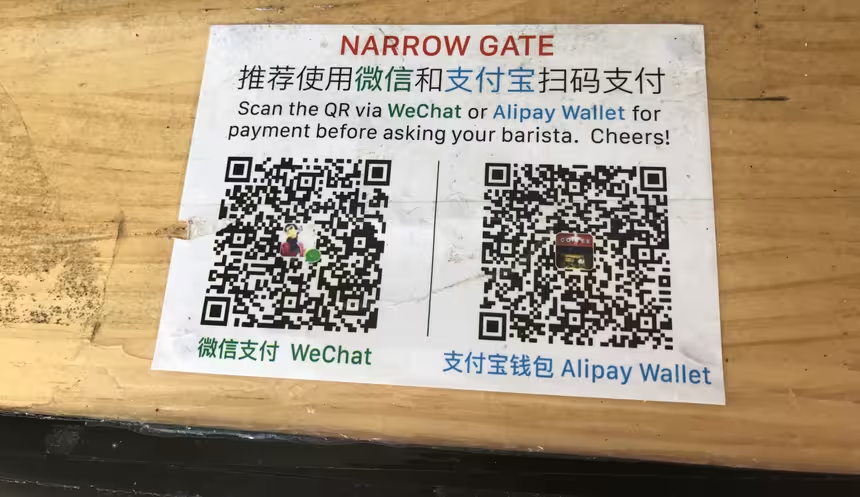
Alipay and WeChat Pay are the dominant mobile wallets. Both allow eligible international cards to be linked and identity to be verified with a passport. Registration is best completed at home on a trusted connection, followed by a small test payment if possible. A mismatch in the spelling of a name or a bank security block is much easier to resolve before the journey than at a restaurant counter.
QR payment works in two directions. A merchant may scan the customer’s payment code, or the customer may scan the merchant’s code and enter the amount. In the second case, check the recipient’s name and the decimal place. Do not pay through an unknown code received in a chat or disclose an authentication message. A mobile wallet deserves the same protection as online banking precisely because it combines so many services.
Visa, Mastercard and other international cards are accepted at hotels, major retailers and a growing number of transport and tourist facilities. Beijing has also expanded contactless metro access with supported foreign cards. A small restaurant or stall may still lack a conventional terminal. The plastic card is therefore an important backup, not a promise of universal acceptance.
Cash in renminbi remains legal tender. It is useful if the phone runs out of power, mobile data fails or a card is declined. A digitally oriented shop may have difficulty changing a large note, so smaller denominations are more practical. Use an ATM belonging to an established bank and compare the bank’s conversion with any dynamic currency conversion offered by a terminal.
Issuer fees, exchange-rate margins and platform limits may be added to the purchase price. Conditions vary by provider and transaction size, so a universal fee table from an old travel video is unreliable. Before departure, check online-payment limits, enable transaction notifications and keep the card-blocking number somewhere other than the phone itself.
A family or work group should not keep all funds in one device. A resilient setup includes two cards on different networks, a mobile wallet, a reasonable amount of cash and a separate reserve. The phone needs a strong lock, biometric protection and a remote-wipe option; a charged power bank solves a more likely problem than an exotic new payment service.
Beijing’s payment system is not hostile to foreign users; it simply has a different hierarchy. A prepared mobile wallet is usually the easiest option, followed by an international card and cash as a robust fallback. Set up more than one route before arrival and the city’s digital speed becomes an advantage rather than an obstacle.