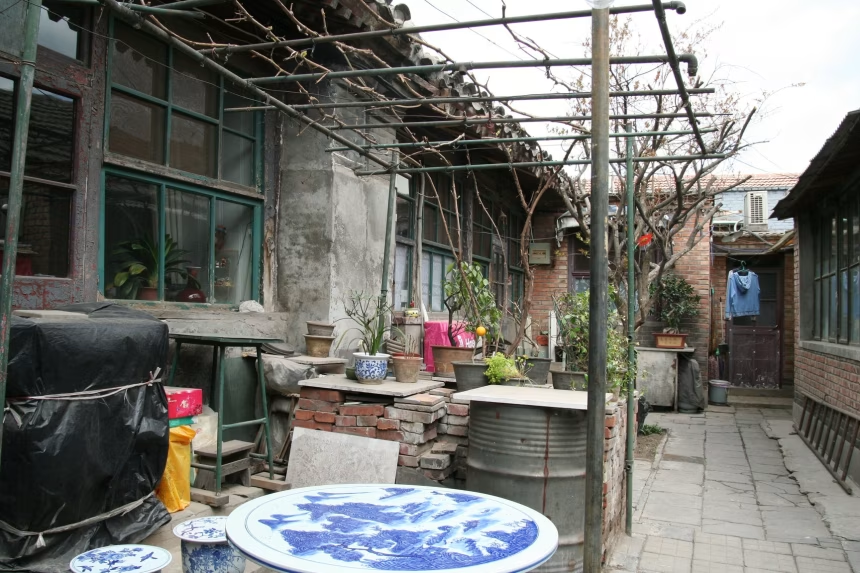
The word hutong describes the lane, not the courtyard house itself. It is generally linked to a Mongolian word for a well and became part of Beijing’s vocabulary as the capital developed under the Yuan, Ming and Qing dynasties. A hutong is therefore both a spatial form and an address system through which neighbourhood life was organised.
Behind the lane walls, the siheyuan courtyard typically arranged rooms around an open centre. Orientation, gate position and the allocation of rooms reflected climate, family hierarchy and available land. The textbook symmetrical compound was an ideal; real houses were divided, extended and adapted as households and population changed.
The lane connected private courtyards to wells, shops, temples, schools and neighbours. Its social importance came from repeated everyday contact. That intimacy could provide mutual aid, but it should not be romanticised. Crowding, shared toilets, weak heating and limited privacy were also real, particularly after compounds were subdivided among many families.
Large-scale redevelopment demolished extensive hutong areas for roads and new housing. Later conservation sometimes created the opposite distortion: picturesque façades, cafés and short-term tourism replacing residents and ordinary services. Preserving roof profiles while removing the community is not complete preservation.
Improvement requires fine judgement. Sanitation, fire access, insulation and utilities must be modernised, yet a standard solution can erase irregular plots and small-scale relationships. Micro-renewal works best when residents participate and when upgrades solve documented needs rather than preparing property for a more affluent market.
Visitors enter a living neighbourhood, not an open exhibition. Closed doors should remain closed and people should be asked before close photography. Walking quietly, noticing street names and using local businesses offers more understanding than searching for a supposedly untouched interior. The hutong’s significance lies in the relationship between lane, courtyard and community memory—not in any one photogenic wall.