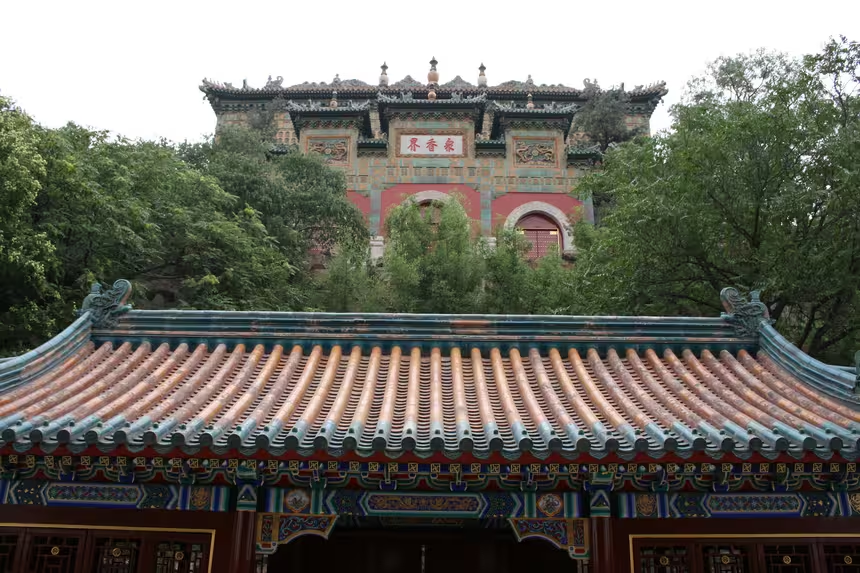
The Summer Palace is frequently introduced as an escape from Beijing’s summer heat. It was also an instrument of government, representation and landscape design. Kunming Lake, Longevity Hill, halls, bridges and long covered walks form a composition in which nature was extensively reshaped to appear effortless.
Chinese garden design does not try to reveal everything at once. A wall, rock or bend delays the view; a framed opening turns a distant tower into part of a nearer courtyard. Paths alternate compression and release, while borrowed scenery extends the apparent boundaries. The garden is best understood in motion rather than from a single panoramic photograph.
Water dominates the plan. Excavated earth helped form the hill, while the lake supported irrigation, boating, reflections and large visual distances. The landscape joins engineering and aesthetics. Maintaining water quality and shorelines remains as important as restoring painted pavilions, because the architecture loses its composition if the lake is treated merely as background.
The palace also carries histories of destruction and political controversy. Anglo-French troops burned the earlier Garden of Clear Ripples in 1860, and reconstruction under the Guangxu emperor and Empress Dowager Cixi became associated with arguments about state finance and naval funds. Simplified legends should not replace evidence, but they reveal how strongly the site is tied to memories of foreign invasion and late-Qing crisis.
The Marble Boat embodies the tension between symbol and function. It is a lakeside pavilion shaped like a vessel, not a working ship, and its imagery of stability attracted later political interpretation. Elsewhere, Suzhou Street stages a commercial town for the court, demonstrating how imperial leisure could turn ordinary urban life into a controlled spectacle.
Today immense visitor pressure changes the garden again. Boats, queues and crowded ridges can obscure the slow sequence for which it was designed. Walking one shore, entering smaller courtyards and allowing changing weather to alter the view offers a better reading than collecting every landmark. The Summer Palace is not nature untouched; it is a sophisticated argument about how power wished nature to look.