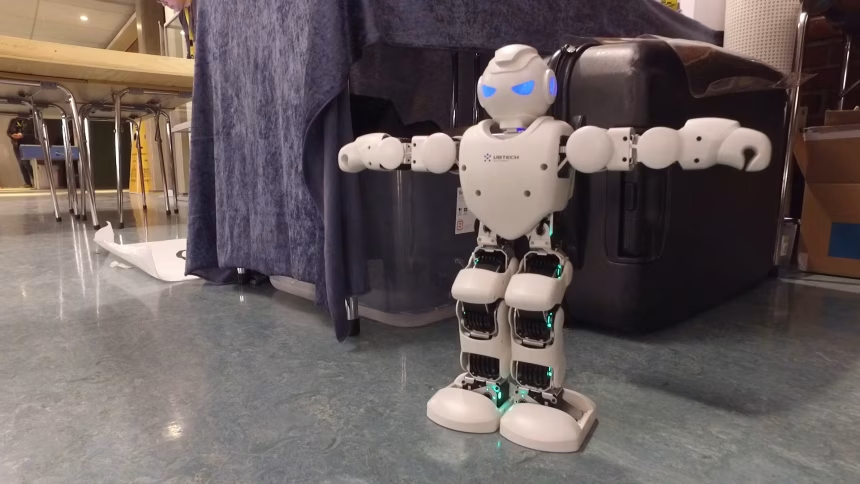
Humanoid robot races attract attention through speed, falls and machines imitating people. The more consequential change is happening away from the stadium. China is pushing laboratories toward repeated work in factories, logistics, energy and services. The scarce resource is not only motors and batteries, but data from thousands of real attempts.
Beijing training centres reproduce homes, shops and industrial stations. A technician may teach a robot to pick up, weigh and replace an item while position and sequence change. Each attempt combines vision, joint motion, grip force and outcome so the machine learns more than one choreography.
Government programmes aim to validate embodied AI in real scenarios and deploy it at larger scale. Targets signal industrial policy, not proof that every robot will be economical. Early tasks are narrow: loading a machine, handling material, inspecting dangerous equipment or carrying goods.
Humanoid form is not universally best. Wheels are more efficient on flat floors and a fixed arm may be faster and safer. Legs and two arms make sense when the environment was built for humans and redesign would cost more. Every deployment should be compared with a specialised machine, not only with human labour.
Safety requires force limits, human detection, secure stopping, logs and clear control of camera data. A system that succeeds 99 per cent of the time may still fail too often across thousands of daily actions. The real benchmark is useful hours between incidents, cost per correct task and safe handling of change—not a sprint record.