Discussion of Chinese AI hardware often asks whether one domestic accelerator can replace Nvidia’s fastest chip. The comparison is understandable and incomplete. Compute comes from architecture, fabrication, memory, packaging, networks, software, cooling and electricity. A bottleneck in any one part restricts the system.
China produces enormous volumes of integrated circuits, but unit counts mix components of very different complexity. Export controls have restricted access to advanced accelerators and manufacturing tools, encouraging investment in domestic design, foundries and software. They slow some capabilities while creating a protected market for alternatives; the supply chain nevertheless remains internationally connected.
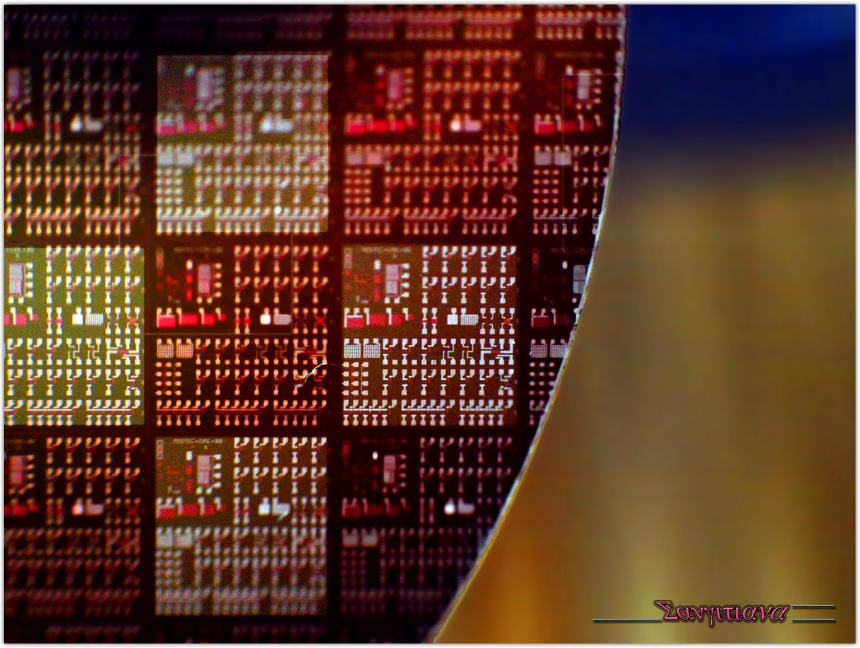
Chip design requires EDA tools to verify billions of elements, timing and power. Beijing’s AI4Chip programme proposes using AI in design, manufacturing, packaging and testing. Models may explore options and detect defects, but a design error multiplies through a production run. Verification is as important as optimisation speed.
Advanced packaging, fast memory and interconnects determine whether thousands of chips behave as a useful cluster. Software is another barrier: compilers and libraries must reliably map models to hardware. A lower theoretical peak can be competitive with a well-designed system and efficient model; an impressive TOPS figure without precision or workload context proves little.
Data centres finally consume power and cooling. Useful work per watt and sustained availability matter more than an isolated maximum. Chinese AI chips are therefore not one winning product but a restructuring of the global supply chain. Success means the complete system can be manufactured, programmed and operated reliably at real scale.