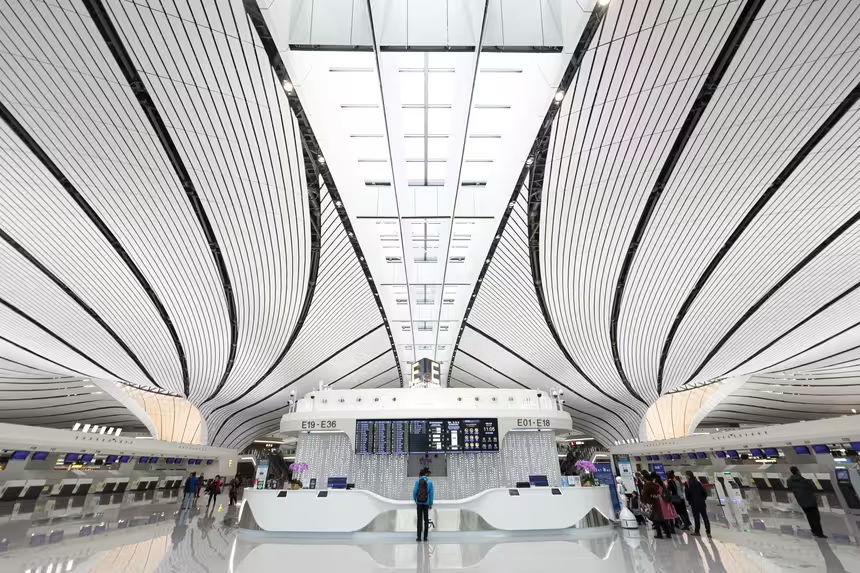
Beijing Daxing International Airport is recognised by its starfish plan and a roof that appears to flow across the terminal. The visual identity is not separate from the operational idea. Zaha Hadid Architects and the project team arranged long piers around a central hall so that an exceptionally large terminal could retain relatively short walking routes and clear orientation.
Airports are small cities governed by time. Departing, arriving and transferring passengers need separate but connected paths; baggage, catering, security and staff move through systems most visitors never see. A beautiful roof cannot compensate for a missed connection. Architecture succeeds only when these flows work during peaks, disruptions and future changes.
The central space gives passengers a repeated point of reference, while roof openings bring daylight deep into the building. Large spans reduce columns and preserve flexibility, but create demanding structural, acoustic and climate-control problems. The terminal must be comfortable across Beijing’s cold winters and hot summers without turning its scale into unlimited energy demand.
Daxing also depends on transport beyond the building. Its southern location created a new relationship with rail, metro, expressways and the wider Beijing–Tianjin–Hebei region. An airport cannot be judged by aircraft capacity alone; the time, cost and reliability of reaching it determine its real accessibility.
Growth raises environmental questions. More efficient operations can reduce energy per passenger, while rising traffic still increases total emissions. Rail substitution on shorter routes, low-carbon power and honest accounting of aviation emissions matter more than a terminal’s green label.
The building’s strongest lesson is that monumentality can emerge from circulation rather than decoration. Its radial form is memorable because it attempts to solve distance and orientation. The long-term test will be whether the terminal remains adaptable, legible and connected as passenger patterns, security technology and climate obligations change.