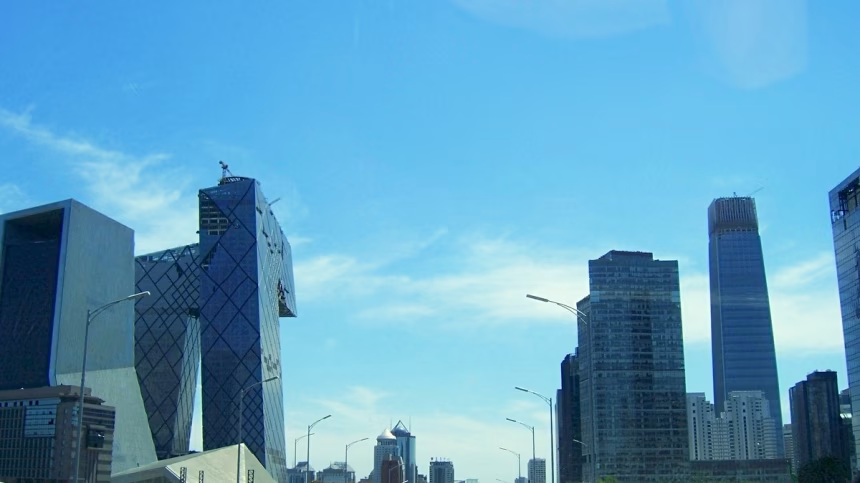
OMA’s CCTV Headquarters bends two towers into a continuous three-dimensional loop. The form became an instant Beijing landmark, but its importance lies in linking television production, administration and broadcasting through one structural and organisational circuit instead of stacking them in a conventional vertical slab.
Two leaning legs rise from separate bases and meet in a dramatic overhang. The diagonal grid visible on the façade is not a graphic pattern applied afterwards; it expresses how loads travel through the irregular structure. Denser diagonals mark areas of greater stress. Engineering becomes part of the building’s public language.
The loop creates adjacency between departments that would otherwise occupy distant floors or separate buildings. This can support collaboration, although architecture cannot by itself change institutional hierarchy. Corridors and shared spaces may connect people physically while editorial and political decisions remain centralised.
Construction required solving wind, earthquake and phased-loading conditions. The final connection was made when temperatures allowed the two halves to align. Such complexity carries cost and embodied carbon, so formal daring must be judged against long service life, adaptability and actual use—not novelty alone.
The building also represents state media, and its image cannot be separated from questions of information and power. Admiring engineering is not an endorsement of the institution, just as political criticism does not make the structure technically uninteresting. The tension is part of its place in contemporary architecture.
Unlike a tower that can be understood from one elevation, CCTV changes as the viewer moves around it: arch, loop, cantilever and frame appear in turn. It alters Beijing’s skyline by making empty space the centre of the composition. The building’s achievement is not simply that it looks unusual, but that structure, circulation and institutional symbolism remain inseparable.