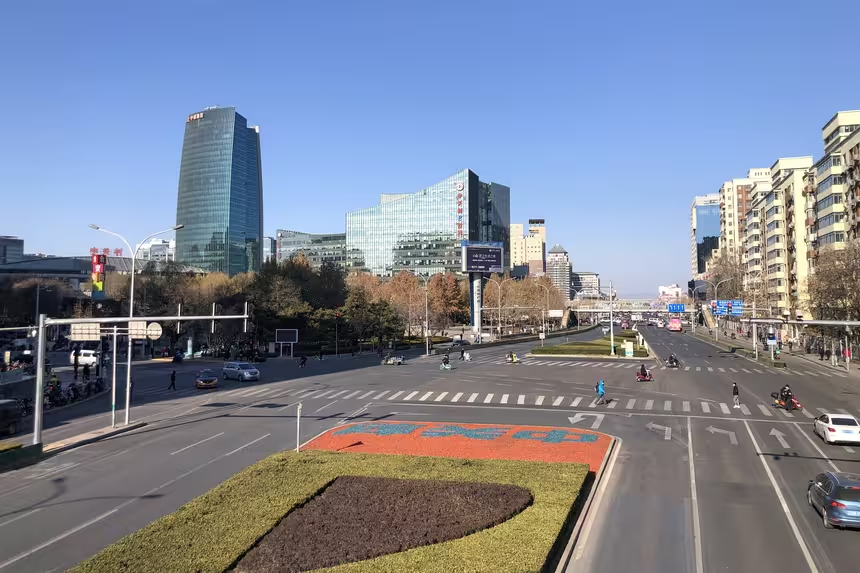
Zhongguancun is often called China’s Silicon Valley. It grew around universities and electronics trading and now describes a network of science parks, laboratories, investors and technology companies across Beijing. AI is its most visible layer, supported by a high concentration of registered large models.
Registration counts are not a quality ranking. They include general systems and models for government, research, education, culture, manufacturing and commerce. Some will gain real use; others remain demonstrations. Counting models can encourage every organisation to build a variant where a secure integration of an existing tool would suffice.
Beijing’s advantage is institutional density: Tsinghua and Peking universities, the Chinese Academy of Sciences, specialist institutes and corporate laboratories allow people to move between research and product. The same concentration increases housing costs and competition for a small number of celebrated experts.
Models need compute, lawful data and deployment partners. Shared parks can lower entry costs, but access must be transparent rather than a subsidy for incumbents. Health, industrial and cultural data carry consent, trade-secret, security and copyright obligations. A mature ecosystem solves these through contracts, standards and audits instead of calling everything a data pool.
Capital also needs patience. Base models, robotics and chip software require years, while investors may seek viral user growth. Zhongguancun’s global influence will come from open technical exchange, reliable deployment and institutions able to connect researchers, manufacturers, hospitals and regulators—not from the number of futuristic cafés or model registrations.